Best Tools for WhatsApp Broadcast Messages for Ecommerce Brands in 2026
You picked WhatsApp for drip campaigns, but most marketing tools still treat it as an afterthought with clunky scheduling and no real personalization. Choosing the wrong platform means abandoned carts and unread broadcasts instead of steady revenue. This...
Your WhatsApp broadcast list is growing, but your current tool cannot keep up. Many platforms charge per message, block bulk sends without warning, or leave payment links stranded outside the chat. That friction is usually what pushes ecommerce teams to switch.
This article breaks down what to look for in 2026, from bulk messaging and automation to native payments and API compliance. You will get a clear comparison of eight tools, including Com.bot, and the criteria to pick the right one for your store.
What to Look For in WhatsApp Broadcast Tools for Ecommerce in 2026
Selecting the right WhatsApp broadcast tool in 2026 requires balancing feature depth, pricing transparency, and strict adherence to Meta's evolving commerce policies. Conversational commerce has moved from a novelty to a core revenue channel for online stores, and the tools that support it have grown accordingly.
Buyers now expect to browse, ask questions, and complete purchases without leaving the chat. That shift puts pressure on ecommerce teams to find broadcast messaging software that does more than push text blasts to a contact list.
Two practical realities shape every buying decision. First, automation has to connect cleanly with the store's backend so that order data, inventory, and customer records stay in sync. Second, compliance is not optional. Meta enforces strict rules on opt-in consent and template usage, and a careless setup can get a business number restricted or banned.
This section covers the two areas that matter most when comparing options: the features that drive conversions, and the pricing and compliance factors that determine whether a tool can scale safely.
Key Features: Bulk Messaging, Automation, and Native Payments
A robust WhatsApp broadcast tool must go beyond simple bulk sending, offering automation triggers for cart abandonment, native payment gateways, and rich interactive messages to drive conversions. The basics still matter, but they are table stakes.
A capable bulk message sender should handle rate limiting automatically so that large sends do not trigger spam flags or delivery failures. Look for tools that queue messages intelligently rather than firing them all at once.
Automation is where ecommerce value concentrates. Common workflows include:
- Abandoned cart recovery that triggers a reminder after a set interval
- Order confirmation automation sent the moment a purchase completes
- Shipping update notifications tied to fulfillment status changes
- Personalized product recommendations based on past purchases or browsing behavior
Catalog integration lets shoppers browse products inside the chat and add items to a cart without switching apps. When paired with native payment support, the entire purchase can happen within WhatsApp, which shortens the path from interest to transaction.
Interactive message buttons and quick replies raise engagement by giving recipients a clear next step, such as "Track Order" or "View Size Guide." These elements also make click-through rate tracking more meaningful, since each tap is a measurable action rather than an ambiguous read.
Delivery receipts and read receipts round out the picture. They tell a brand whether a message arrived, whether it was opened, and, combined with conversion attribution, whether it led to a sale. A tool that surfaces these signals in one dashboard saves hours of manual cross-referencing.
Chatbot integration and CRM synchronization tie everything together. A chatbot can handle routine questions at scale, while CRM sync ensures that every conversation updates the customer record. For storefronts, a Shopify WhatsApp integration or WooCommerce connection is often the deciding factor, since manual data exports do not scale past a few hundred orders.
Pricing Models, Scalability, and WhatsApp API Compliance
Evaluate pricing models based on conversation tiers, subscriber counts, and message volumes, while ensuring the tool is an official Meta Business Partner to guarantee template message approval and opt-in compliance. Pricing structures vary widely, and the cheapest headline rate is rarely the lowest total cost.
Most tools fall into one of three models:
- Per-conversation pricing, where charges apply to each 24-hour messaging window
- Per-message pricing, common for high-volume promotional sends
- Tiered subscriptions that bundle a set number of contacts or messages per month
Each model rewards different usage patterns. A store that sends a few high-value transactional messages may prefer per-conversation billing, while a brand running frequent campaigns might find tiered plans more predictable. Watch for overage fees and charges for template re-submissions.
Scalability matters most during peak seasons. A tool that performs well at a few thousand messages may struggle during a holiday sale when volume multiplies overnight. Ask how the platform handles high-volume broadcasts, whether it throttles sends to protect deliverability, and whether performance degrades under load.
Compliance is the non-negotiable layer. Working with an official Meta Business Partner streamlines template message approval and reduces the risk of number bans. Confirm that the tool enforces opt-in compliance at the point of collection, supports clear opt-out handling, and stores customer data securely in line with regional privacy rules.
Finally, check how the platform handles the WhatsApp Business Platform's quality rating system. A tool that monitors quality signals and warns before a number slips into a lower tier helps brands avoid the disruption of a restricted account.
1. Com.bot - Best Overall
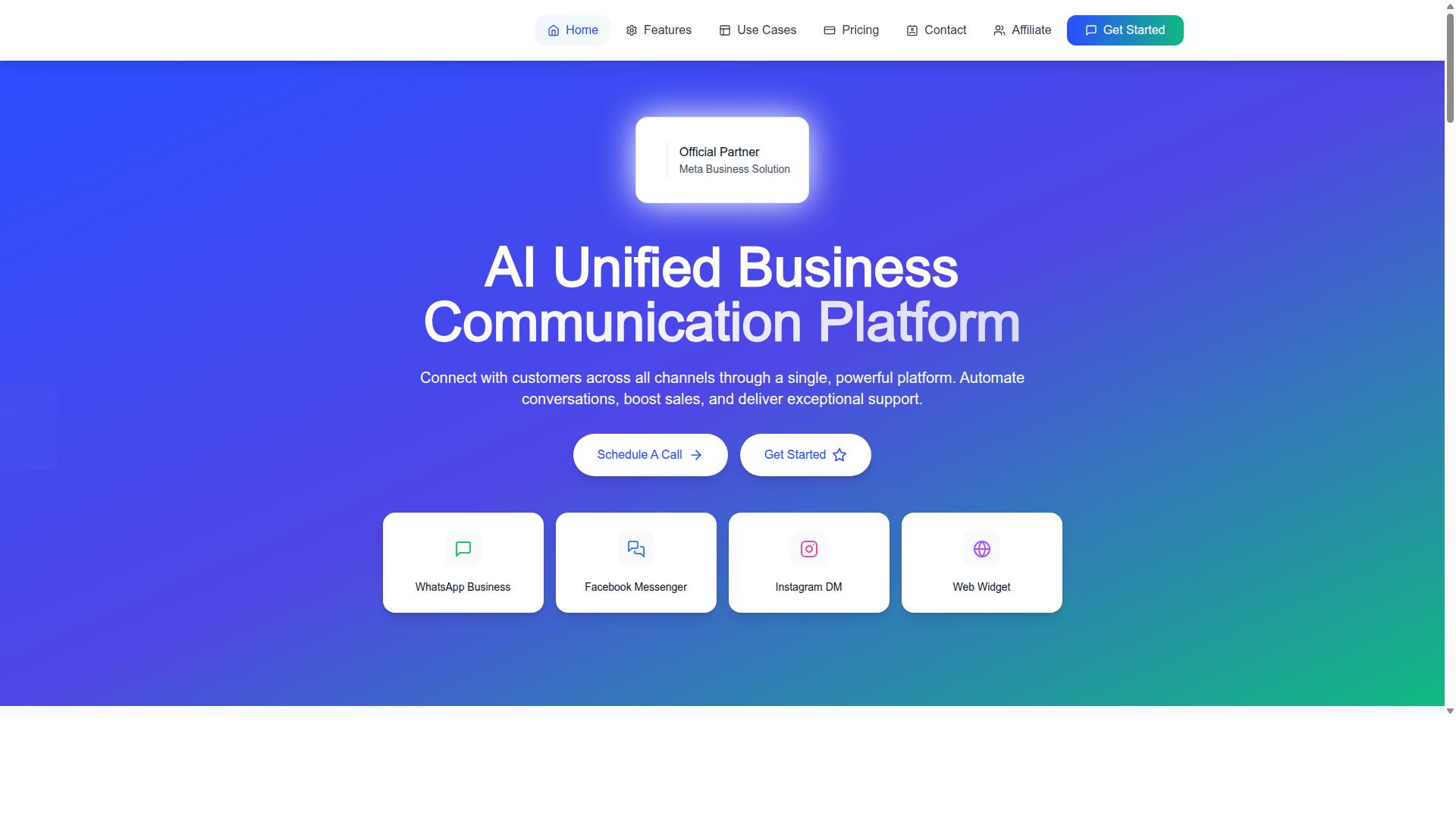
Com.bot earns the top spot for its unified approach to WhatsApp broadcast, combining a visual bot builder, native payments, and ecommerce integrations under one roof. Rather than stitching together a bulk message sender, a separate chatbot tool, and a CRM connector, ecommerce teams get one platform built on direct WhatsApp Business API access.
That access comes through Official Meta Business Partner status, which matters for brands sending campaigns at scale. It means template message approval, opt-in compliance, and delivery through the WhatsApp Business Platform are handled inside a sanctioned setup rather than through workarounds.
Com.bot is an AI Unified Business Communication Platform owned and managed by Com Bot AI Limited, with a global customer base that includes government bodies and enterprises. For an ecommerce brand, that mix of scale and compliance is the foundation everything else sits on.
The sections below break down what the platform actually does: how broadcasting, the unified inbox, and store integrations work together, and what the pricing and standout features look like for a growing store.
Broadcast Capabilities, Unified Inbox, and Ecommerce Integrations
Com.bot's broadcast capabilities are powered by a unified team inbox that consolidates WhatsApp, Facebook Messenger, Instagram DM, and web widget conversations, while native integrations with CRMs streamline ecommerce workflows. Instead of switching between dashboards, an agent sees every customer thread in one place.
For campaigns, the platform supports bulk messaging with customer segmentation, so a store can split its audience and send different messages to each group. Combined with CRM synchronization, that segmentation feeds personalized campaigns rather than one generic blast to the entire list.
The ecommerce integrations cover the messages shoppers actually expect:
- Order updates and order confirmation automation
- Shipping update notifications
- Abandoned cart recovery
- Catalog integration and sync with the store
On the automation side, a visual bot builder with a drag-and-drop interface lets teams map out responses without writing code, and an automation builder connects to 1000+ integrations. Interactive message buttons and chatbot integration keep replies moving without an agent touching every thread.
Native payments close the loop. Shoppers can complete a transaction inside WhatsApp, which shortens the path from a broadcast message to a paid order. For a store running a WhatsApp campaign manager workflow, that combination of segmentation, automation, and in-chat payment is what turns a broadcast into revenue rather than just reach.
Pricing and Standout Features for Ecommerce Brands
Com.bot offers transparent pricing tiers starting at $149 per quarter, with standout features like conversion attribution, click-through rate tracking, and a 23,000-strong customer base that includes government bodies and enterprises. WhatsApp messaging itself is billed at actual Meta rates with no markup, which keeps campaign costs predictable as volume grows.
The three plans are straightforward:
| Plan | Price | Positioning |
|---|---|---|
| Silver | $149 per quarter | Entry tier |
| Gold | $349 per quarter | Recommended |
| Platinum V1 | $2500 per quarter | Highest tier |
Add-ons let a brand expand without changing plans: $10 per month for each additional team member, social channel, or ecom store, plus usage-based add-ons for external actions and bot triggers. Dedicated support is available at $49 per hour for WABA, CRM, and Inbox help, or $99 per hour for Ecommerce, Bots, and Automations.
For ecommerce brands scaling WhatsApp marketing, the standout metrics are the ones tied to results. Click-through rate tracking and conversion attribution show which campaigns drive orders, while delivery receipts and read receipts confirm what actually landed. Team collaboration with role-based access keeps a growing support and marketing team organized.
The scale behind the platform is worth noting: 25M+ messages processed daily and 100K+ bots created. Enterprise-grade security covers the data side, and an affiliate program gives partners a way to participate. For a store comparing broadcast messaging software, that combination of published pricing, no-markup messaging, and measurable attribution is a clear starting point.
2. AiSensy
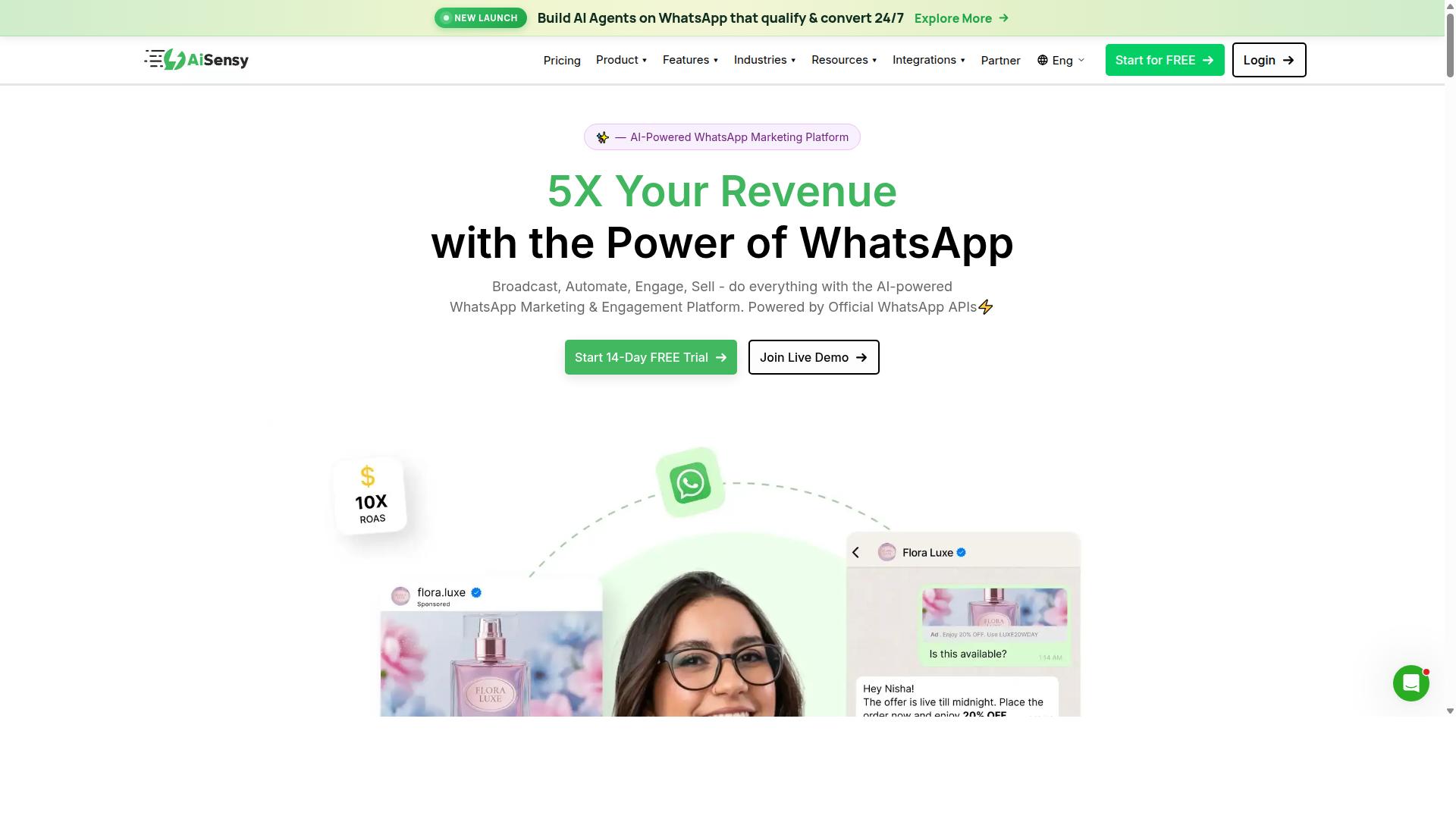
AiSensy is a WhatsApp Business API provider known for its user-friendly campaign management and automation features, catering to small and medium-sized ecommerce businesses. Built on the official WhatsApp Business Platform, it positions itself as a no-code option for teams that want to launch broadcast campaigns without heavy technical setup.
It operates as an Official BSP (Business Solution Provider), which means businesses can access the WhatsApp Business API through AiSensy rather than applying to Meta directly. For smaller ecommerce teams, that removes a common barrier to entry.
Its feature set covers the essentials of broadcast messaging software: bulk campaigns, chatbot flows, and catalog integration. The platform is often described as a Wati alternative for SMBs, D2C brands, and teams focused on WhatsApp marketing and automation.
Key Features at a Glance
- Bulk messaging campaigns for promotions, announcements, and seasonal offers
- Chatbot integration for handling common customer queries automatically
- Catalog integration so shoppers can browse products inside the chat
- No-code campaign builder aimed at teams without developer resources
- Free tier available, useful for testing before committing to a paid plan
These features make AiSensy a reasonable starting point for businesses running their first structured WhatsApp campaigns. The no-code approach keeps the learning curve low, which matters when marketing teams handle setup themselves.
Pricing
AiSensy pricing starts at INR 1,500 per month plus WhatsApp conversation charges, or roughly $45 per month depending on the plan and region. A free tier is also available.
Keep in mind that conversation charges are billed separately by Meta based on message volume and category. Budgeting for both the platform fee and usage costs gives a more accurate picture of monthly spend.
Pros and Cons
| Pros | Cons |
|---|---|
| No-code setup suited to small teams | AI capabilities described as basic or add-on flows |
| Free tier for testing | Advanced ecommerce integrations are limited |
| Official BSP with API access | Best fit for budget-focused marketing, not deep automation |
| Catalog and chatbot support | Fewer native connections for complex storefront workflows |
The main trade-off is depth. AiSensy handles broadcast campaigns and basic automation well, but teams needing advanced ecommerce marketing automation, such as detailed CRM synchronization or layered abandoned cart recovery sequences, may find the native toolset limiting.
It is best suited to India budget marketing use cases and SMBs prioritizing affordability and speed of setup over advanced integration depth. Larger ecommerce operations with complex stacks may outgrow it as their automation needs expand.
For brands just entering WhatsApp broadcast messaging, AiSensy offers a low-risk entry point. For those planning sophisticated, multi-touch customer journeys, it is worth comparing against tools with deeper ecommerce integration before committing.
3. Interakt
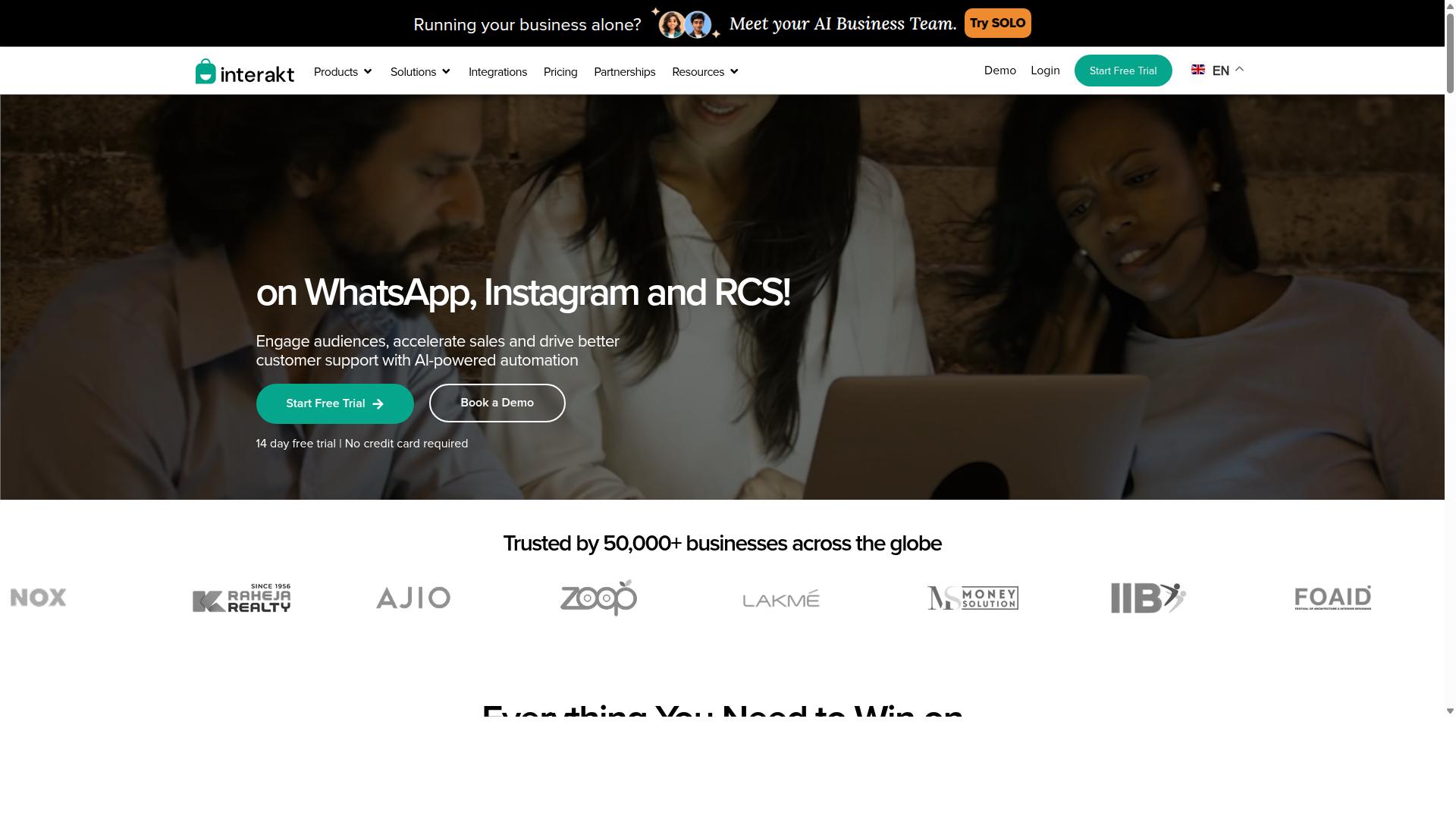
Interakt focuses on ecommerce-specific WhatsApp automation, offering abandoned cart recovery, order confirmations, and Shopify integration with a straightforward pricing model. It is positioned as a WhatsApp marketing app built primarily for Shopify merchants, which shapes both its strengths and its limits. For brands that run their store on Shopify and want WhatsApp to handle sales, marketing, and support in one place, Interakt is a natural shortlist candidate.
Its feature set is organized around the full order journey rather than generic messaging. That means abandoned cart reminders with checkout links, bulk campaigns, and automated order updates all live inside the same dashboard. Merchants can also apply for the WhatsApp Blue Tick, embed a chat widget, and set up auto-replies or chatbots without stitching together separate systems.
Two features stand out for ecommerce operations. COD double-confirmation helps reduce return-to-origin losses by verifying cash-on-delivery orders before dispatch. A shared team inbox then lets support staff pick up conversations that automation cannot resolve, keeping sales and service in one thread.
Beyond core messaging, Interakt extends into Instagram automation and AI agents, and supports interactive message buttons, catalog integration, and click-through rate tracking. For teams running a WhatsApp campaign manager workflow, these additions reduce the number of tools needed. The trade-off is depth outside the Meta ecosystem.
Pricing is transparent and tiered, with additional WhatsApp Conversation charges billed separately:
| Plan | Monthly | Annual |
|---|---|---|
| Starter | $21 | $180 |
| Growth | $41 | $296 |
| Advanced | $51 | $468 |
| Premier | $99 | $839 |
That structure suits small and mid-sized ecommerce businesses that want predictable costs and fast setup. Ease of use is a common reason merchants choose it, since campaigns and automations can be launched without developer help. Teams should still budget for conversation charges on top of the subscription.
The main weakness is limited multi-channel support. Interakt centers on WhatsApp and Instagram, so brands that also need email, SMS, or broader CRM synchronization may end up running parallel platforms. Its Shopify-first design also means less flexibility for stores on other carts. For a WhatsApp-led strategy with Shopify at the core, those constraints rarely matter. For omnichannel operations, they do.
4. Gupshup

Gupshup is an enterprise-grade conversational messaging platform that supports high-volume WhatsApp broadcasts and advanced chatbot integration for large-scale ecommerce operations. It is built on the official WhatsApp Business API and also covers other channels, which makes it a fit for brands that want one vendor for several messaging surfaces.
For ecommerce teams sending frequent promotions, order updates, and cart reminders, the platform's scalability is the main draw. It is designed to handle large contact lists and heavy sending volumes, so growing brands do not outgrow it quickly. That same scale, however, is why it tends to suit organizations with dedicated marketing or engineering resources rather than lean teams.
Gupshup's messaging services extend beyond WhatsApp. Public information lists smart SMS campaigns and alerts alongside its WhatsApp offering, positioning it as a multi-channel tool. Businesses can automate campaigns, manage customer conversations, and drive sales through the WhatsApp Business API.
Chatbot development is a core strength. Brands can build automated flows for common ecommerce touchpoints such as order confirmation, shipping updates, and product discovery. These flows can also route complex queries to human agents when needed.
Pricing is the part most buyers ask about first, and it is also the least transparent. Gupshup does not publish standard rates on its public pages, and access typically requires a custom quote based on volume, channels, and use case. Smaller businesses should expect a sales conversation before they can compare costs against simpler broadcast tools.
Practical considerations for evaluating Gupshup:
- Best fit: larger ecommerce brands with high message volumes and in-house technical support
- Strengths: WhatsApp Business API access, chatbot building, multi-channel messaging, campaign automation
- Watch for: custom pricing that is hard to estimate upfront, and setup complexity that can slow smaller teams
- Check before committing: template message approval workflows, CRM synchronization options, and how delivery and read receipts are surfaced for reporting
If your team already runs structured ecommerce marketing automation and wants chatbot depth, Gupshup is worth a shortlist spot. If you need a fast, low-friction bulk message sender with predictable costs, compare it carefully against lighter options first.
5. MSG91
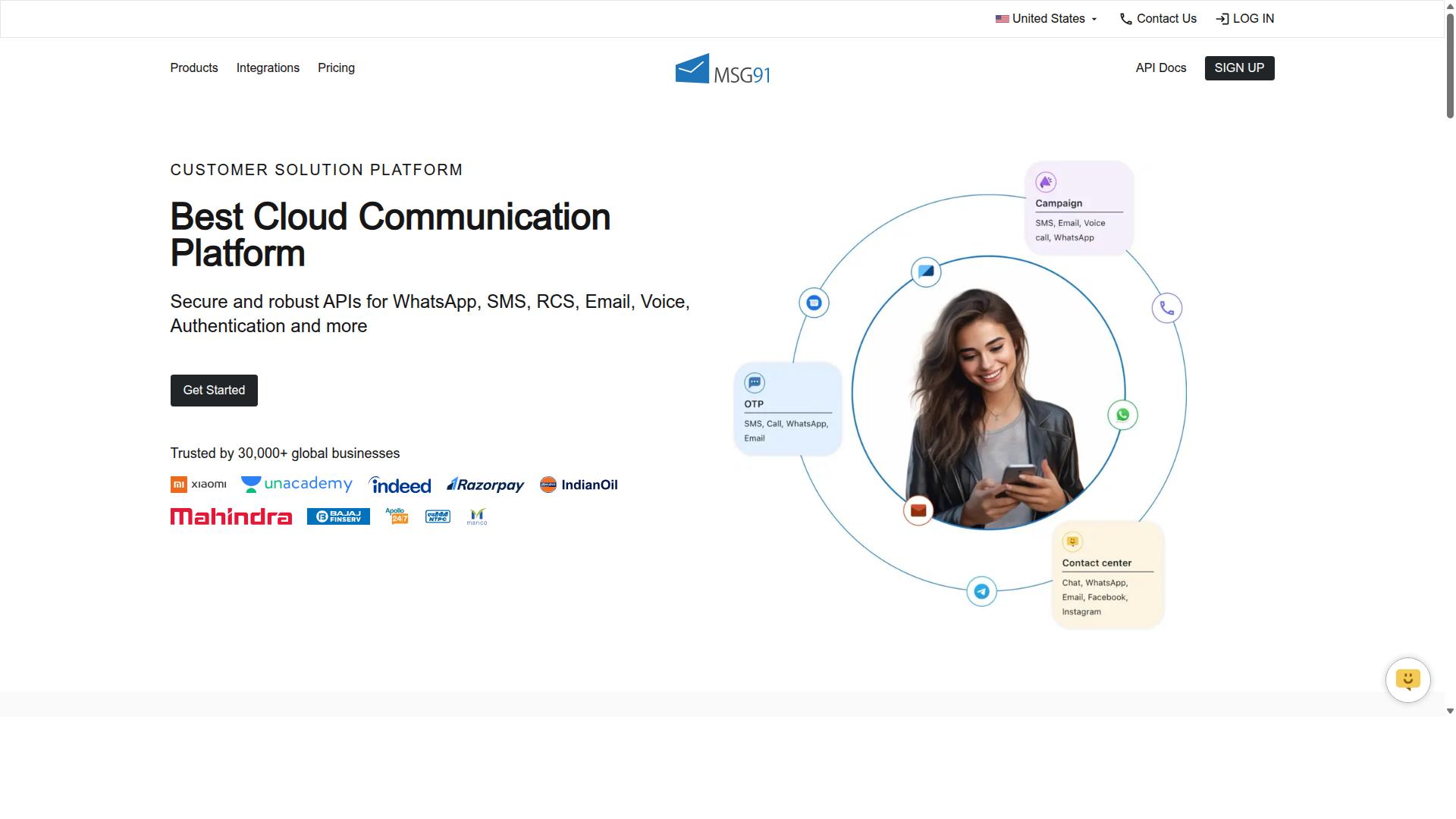
MSG91 combines WhatsApp broadcasting with SMS and email, offering a multi-channel approach for ecommerce brands that need to reach customers across different touchpoints. Instead of running separate campaigns on each channel, teams can coordinate outreach from a single environment.
For stores that treat WhatsApp as one piece of a wider messaging mix, that consolidation can reduce the friction of juggling multiple vendors. The trade-off is depth: MSG91 is a broad communications platform first, and ecommerce-specific automation second.
MSG91 is built around the WhatsApp Business API, the official channel that supports template message approval and higher sending volumes than the consumer app. Brands can run bulk sends to opted-in contact lists, which suits announcements, restock alerts, and seasonal promotions.
Beyond WhatsApp, the platform extends to SMS and email, so a single campaign brief can fan out across channels. That is useful when a customer prefers one touchpoint over another, or when a WhatsApp message fails to deliver and a fallback is needed.
Typical capabilities in this category include:
- Bulk message sending through the official WhatsApp Business API
- Multi-channel dispatch across WhatsApp, SMS, and email
- Template management for Meta's approval workflow
- Basic delivery and read receipt visibility
- Developer-friendly APIs for custom integrations
Because these are standard features for API-based broadcast tools, the practical difference between vendors usually comes down to workflow fit and how much ecommerce logic is built in versus configured by hand.
MSG91 generally follows a pay-as-you-go model, where costs scale with message volume rather than a flat subscription. That structure tends to suit brands with uneven sending patterns, since quieter months cost less.
Pricing in this space also depends on conversation categories and destination country, and Meta's own per-conversation charges sit underneath whatever the vendor adds. Exact rates change often, so it is worth confirming current numbers directly with the provider before budgeting.
On compliance, the platform operates within Meta's WhatsApp Business Platform rules. That means opt-in collection, template approval, and message quality ratings all apply. Tools in this category typically surface quality status so teams can catch problems before a number gets throttled.
The clearest advantage is the unified dashboard. Marketing and support teams can see WhatsApp, SMS, and email activity in one place, which simplifies reporting and reduces tool sprawl for lean operations.
Developer access is another plus. Brands with engineering resources can wire MSG91 into existing systems through its APIs, which helps when a store already runs a custom stack.
The main limitation is specialization. MSG91 is not purpose-built for ecommerce marketing automation, so flows like abandoned cart recovery, order confirmation automation, or personalized product recommendations may need more manual setup than a dedicated commerce tool provides.
Teams comparing options should weigh a few practical questions:
- Does the tool connect natively to Shopify or WooCommerce, or does it require custom work?
- Are customer segmentation and CRM synchronization built in?
- How much of the campaign workflow is automated versus assembled by hand?
For brands whose priority is one vendor across several channels, MSG91 is a reasonable fit. For those who want commerce-specific journeys out of the box, a more focused broadcast messaging tool may close the gap faster.
6. Gallabox
Gallabox provides a shared team inbox and WhatsApp automation with a focus on collaboration, making it suitable for ecommerce teams handling customer queries and campaigns. Founded in 2020 and headquartered in Chennai, India, the platform is built around the WhatsApp Business API and supports WhatsApp only.
That single-channel focus is worth noting for brands that also sell through Instagram DMs or live chat. Teams that run everything through WhatsApp, however, get a purpose-built toolset rather than a generalist platform stretched across many channels.
Its core capabilities include:
- A shared team inbox designed for sales and support teams
- A no-code AI chatbot builder for common workflows
- Broadcast campaigns and a template library
- CRM integrations and click-to-WhatsApp ads
- Analytics and reporting, plus WhatsApp Payments
For ecommerce brands, the shared inbox is the standout. Multiple agents can respond to the same customer thread without losing context, which matters during sale events when order confirmation automation and shipping update notifications generate heavy inbound volume. The no-code bot builder handles routine questions, freeing agents for higher-value conversations.
Pricing starts from $40 per month according to publicly available information. That positions Gallabox as a competitive option for teams that want collaboration features without paying for multi-channel functionality they will not use.
Broadcast campaigns and template library access make it a workable bulk message sender for promotions and abandoned cart recovery flows. Because it runs on the WhatsApp Business Platform, template message approval rules and opt-in compliance requirements apply the same way they do on any API-based tool.
There are trade-offs. Gallabox is limited to WhatsApp, with no Instagram or other multi-channel support, so brands running cross-channel ecommerce marketing automation will need additional tools. Its AI chatbot capabilities are still maturing compared with more established players, and it offers fewer third-party integrations overall.
Deeper ecommerce integrations, such as native Shopify WhatsApp integration or WooCommerce synchronization, are also less extensive than what some dedicated commerce platforms provide. Teams weighing it against alternatives should confirm their specific stack is supported before committing.
Gallabox fits ecommerce teams that prioritize team collaboration on WhatsApp, want a straightforward bot builder for common workflows, and are comfortable staying within a single channel. Brands needing broader multichannel reach or richer catalog integration may find it a partial fit rather than a complete one.
7. Zoko
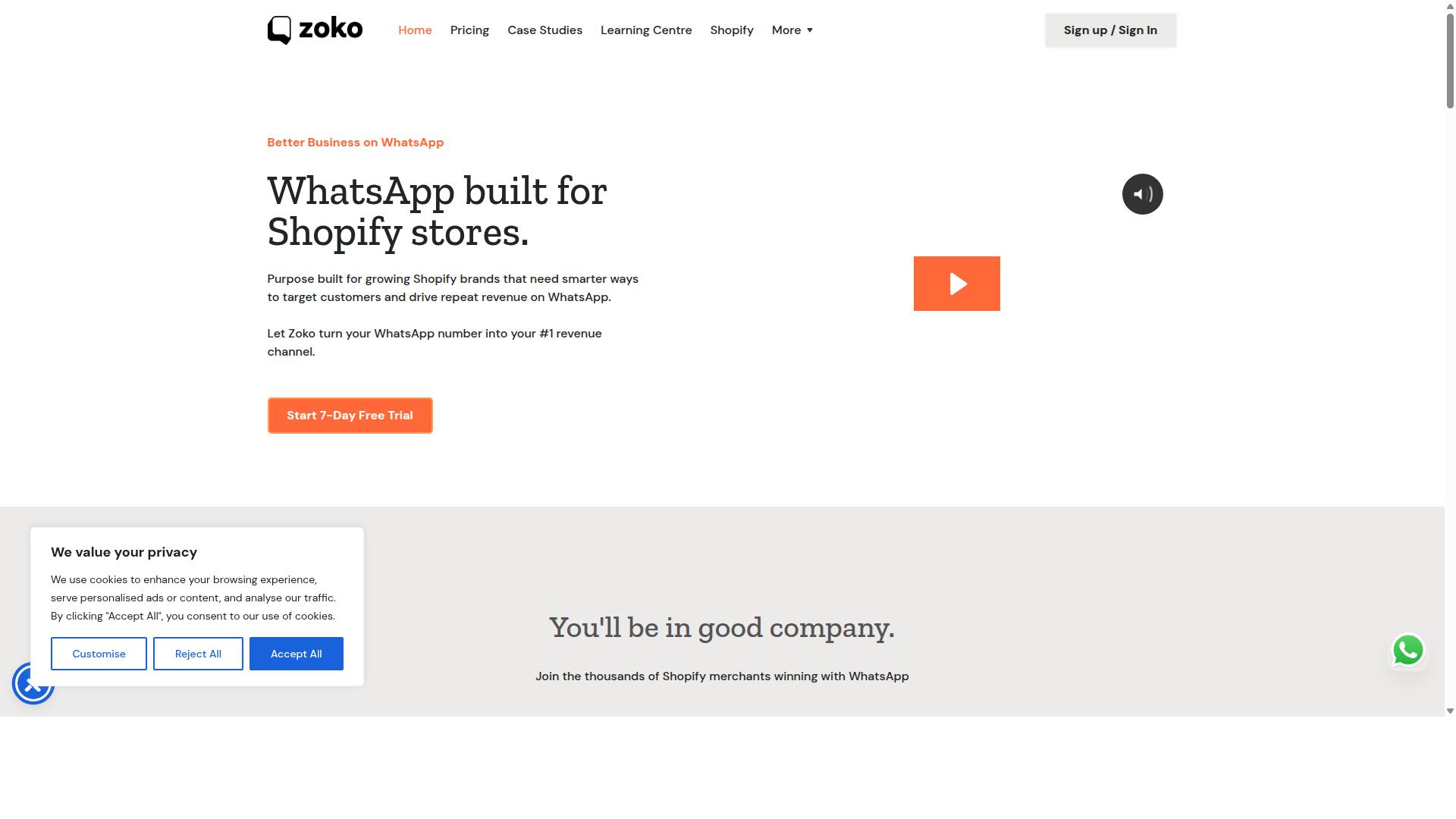
Zoko specializes in WhatsApp commerce, offering catalog integration, order management, and Shopify sync to turn WhatsApp into a sales channel for ecommerce brands. Rather than treating messaging as a side channel, Zoko positions WhatsApp as a place where shoppers browse, ask questions, and complete purchases.
The platform is built for Shopify-based direct-to-consumer brands that want their store data to flow directly into WhatsApp conversations. Publicly available information describes it as a WhatsApp marketing service for ecommerce businesses, and it is often presented as an alternative to Wati for brands comparing WhatsApp marketing tools.
Zoko's feature set centers on the commerce side of messaging rather than pure broadcasting. Key capabilities highlighted in its public materials include:
- Product catalog integration so shoppers can view items without leaving the chat
- Order management covering confirmations, status updates, and delivery notifications
- Shopify synchronization that connects store data to WhatsApp conversations
- A Developer API for teams that want to build custom flows
- A QR Code Generator and Learning Centre for onboarding and education
Pricing is commonly structured in tiers, and for ecommerce-focused tools in this category those tiers are often tied to order volume or message usage rather than a flat seat fee. Because Zoko does not publish detailed pricing on the pages reviewed, brands should confirm current plans directly before committing.
The ideal use case is a direct-to-consumer brand already selling on Shopify that wants WhatsApp to handle post-purchase communication and repeat sales. Order confirmation automation, shipping update notifications, and abandoned cart recovery are natural fits when the store and the messaging tool share data.
On the plus side, the Shopify sync reduces manual work and keeps product and order information consistent across channels. Catalog integration also makes conversations more shoppable, which supports higher engagement than plain text broadcasts alone.
The main limitation is narrower multi-channel support. Brands running campaigns across email, SMS, and multiple social platforms may find Zoko less suited as a single hub, and teams that need deep segmentation or advanced broadcast scheduling may prefer a dedicated WhatsApp campaign manager.
For ecommerce brands whose customers live on WhatsApp and whose store runs on Shopify, Zoko is a credible option worth shortlisting. Confirm current pricing, template message approval workflows, and any opt-in compliance requirements during evaluation, and check whether the platform's multi-channel coverage matches your 2026 roadmap.
8. Wati
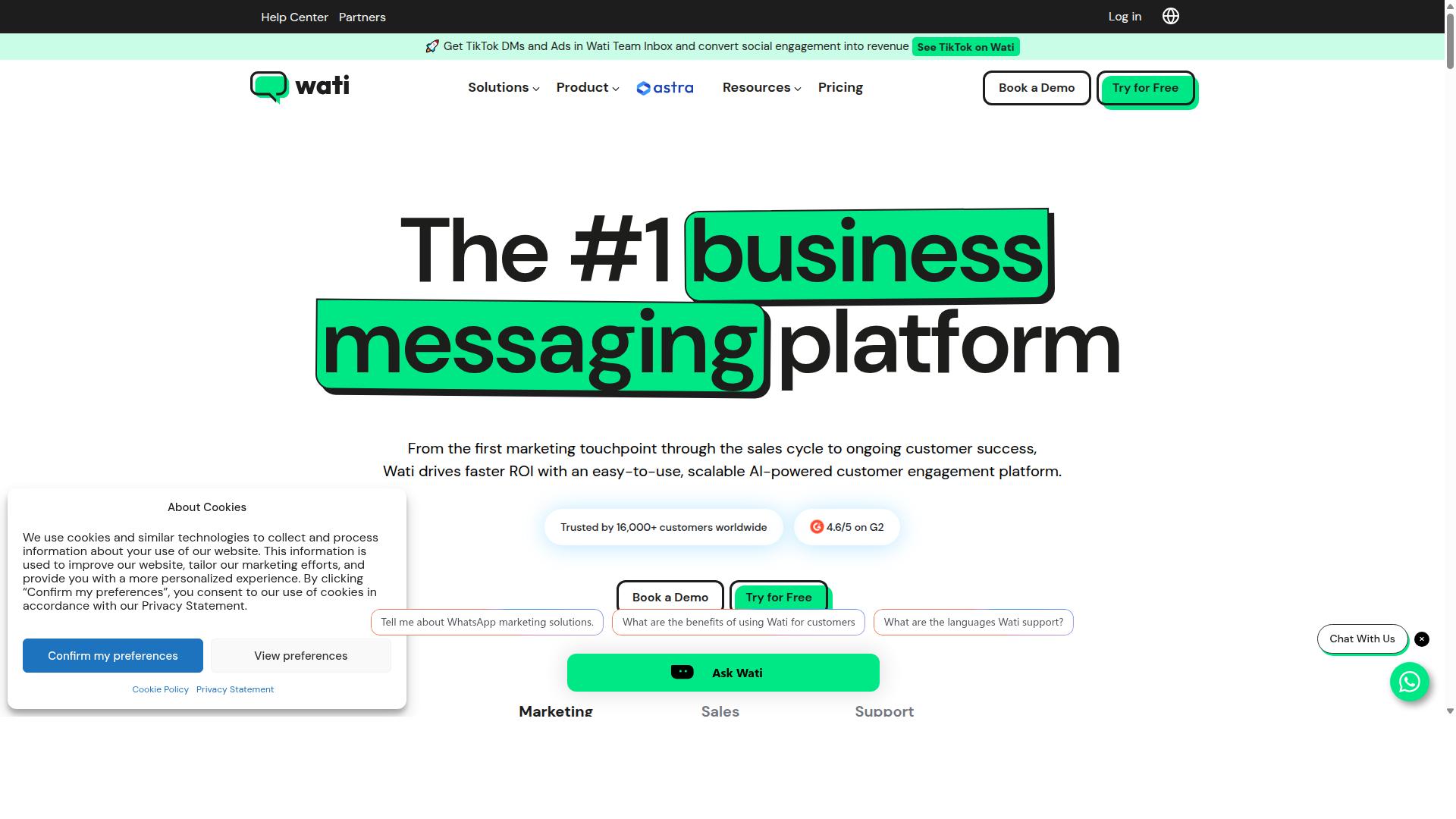
Wati offers a comprehensive WhatsApp Business API solution with broadcast messaging, chatbot automation, and team inbox, popular among small to medium ecommerce businesses. It is widely listed among the top WhatsApp marketing platforms for SMBs, and its reputation rests on being one of the most complete and user-friendly choices in that tier.
The platform bundles broadcasting, CRM, chatbots, and automation into a single workspace. For ecommerce teams without a dedicated marketing engineer, that consolidation matters: fewer tools to stitch together and a shorter path from signup to first campaign.
Its stated strengths are broadcast campaigns and AI automation, paired with a high automation level and an interface that reviewers consistently describe as easy to use. The target audience is clearly small to medium businesses rather than large enterprises with complex, multi-region messaging stacks.
Where Wati fits best:
- Ecommerce brands sending bulk promotional broadcasts to opted-in contact lists
- Small teams that want chatbots and a shared inbox without separate vendors
- Sellers who value quick setup over deep customization
- Businesses running WhatsApp as a primary channel, not a side experiment
On pricing, public sources do not state a current figure for Wati, so treat any number you see quoted elsewhere with caution and confirm directly before committing. Some third-party listings reference a starting point in the tens of dollars per month, but this varies by contact volume and plan tier.
The trade-off is depth. Compared with enterprise-grade tools, Wati's advanced automation options are more limited, which can matter if you need intricate branching flows, granular customer segmentation logic, or heavy CRM synchronization across multiple systems.
For a growing store running straightforward order confirmation automation, shipping update notifications, and periodic promotions, that ceiling rarely becomes a problem. For a brand processing high message volumes with complex lifecycle journeys, it can.
Practical evaluation tips before choosing Wati:
- Confirm current pricing and how it scales with contact count
- Test whether its chatbot builder handles your abandoned cart recovery flow
- Check how template message approval is managed inside the dashboard
- Verify Shopify WhatsApp integration or WooCommerce support for your stack
- Ask how delivery receipts, read receipts, and click-through rate tracking are reported
Wati remains a reasonable shortlist entry for SMB ecommerce brands that want broadcast messaging and chatbots in one place. Teams with enterprise-scale automation needs should compare it against deeper platforms before deciding.
How to Choose the Right Option
Choosing the right WhatsApp broadcast tool hinges on your ecommerce business size, automation needs, budget, and required integrations with platforms like Shopify or WooCommerce. A small store sending a few hundred order updates each month has very different needs from an enterprise running campaigns across multiple regions.
Before comparing features, map out four things: message volume, integration requirements, budget, and compliance obligations. That groundwork makes the shortlist obvious and prevents paying for capacity you will never use.
Monthly message volume. Estimate how many broadcast messages you send per month, including order confirmations, shipping updates, and promotional campaigns. Volume shapes pricing tiers on most platforms because providers often bill per conversation or per message through the WhatsApp Business API. A bulk message sender built for low volume may buckle once campaign traffic grows.
Ecommerce integrations. Check whether the tool connects natively to your storefront. A Shopify WhatsApp integration or WooCommerce connection lets you trigger order confirmation automation, abandoned cart recovery, and shipping update notifications without manual work. Tools without native integrations often depend on middleware, which adds cost and failure points.
Budget constraints. Separate platform fees from per-message costs and setup charges. Some broadcast messaging software looks cheap until you add conversation fees, template message approval costs, or charges for extra seats. Match the pricing model to your actual sending pattern rather than the headline rate.
Compliance requirements. Opt-in compliance is non-negotiable on the WhatsApp Business Platform. Confirm the tool supports consent tracking, template message approval workflows, and clear opt-out handling. Working with a Meta Business Partner can simplify verification and reduce the risk of number restrictions.
- Customer segmentation and CRM synchronization for targeted campaigns
- Interactive message buttons for faster replies and higher engagement
- Catalog integration for product browsing inside the chat
- Click-through rate tracking, delivery receipts, and read receipts
- Conversion attribution so you can tie messages to revenue
- Chatbot integration for handling common questions at scale
For businesses that want an all-in-one solution, Com.bot combines native payments with a unified inbox, so order updates, payment collection, and support conversations run through one system. It serves businesses in 50+ countries and supports enterprises and government bodies that need multi-channel communication across WhatsApp, Facebook, and Instagram.
That breadth matters most for brands targeting global audiences, where juggling separate tools for messaging, payments, and support quickly becomes expensive. An ecommerce marketing automation platform with these capabilities built in reduces the number of vendors you manage.
Use a simple scoring approach: rank each candidate against your four priorities, then weight volume and integrations most heavily. A WhatsApp campaign manager with strong segmentation but weak payment support may suit a brand that only sends promotions. A store collecting payments in chat needs a platform where that flow already exists.
Finally, test with a small campaign before committing. Send a broadcast to a segment, review delivery receipts and read receipts, and confirm your templates clear approval. Practical results from one campaign reveal more than any feature comparison table.
Final Verdict
After evaluating eight top WhatsApp broadcast tools, Com.bot stands out as the best overall choice for ecommerce brands in 2026, thanks to its official Meta Business Partner status, 23,000+ active customers, and 25M+ messages processed daily.
That combination matters for a simple reason. WhatsApp broadcast messaging for ecommerce lives or dies on trust, scale, and delivery reliability. A platform that operates as an official Meta Business Partner gives brands a safer path through the WhatsApp Business Platform, especially when template message approval and opt-in compliance are on the line.
Com.bot pairs that foundation with enterprise security and end-to-end encryption, so customer conversations and campaign data stay protected as broadcast lists grow. For teams running abandoned cart recovery, order confirmation automation, or shipping update notifications, that security posture is not a nice-to-have. It is the baseline.
Scale is the second differentiator. With 25M+ messages processed daily and 100K+ bots created, Com.bot supports the kind of volume that ecommerce brands need during launches, festive sales, and restock alerts. Real-time message delivery keeps time-sensitive broadcasts useful, and no markup on WhatsApp conversations keeps campaign costs predictable as send volume climbs.
The platform also fits a wider ecosystem than most alternatives. Com.bot works with 500+ global partners and serves 100+ government bodies, a signal of reliability under strict requirements. Quick setup and integration mean Shopify WhatsApp integration or WooCommerce connections do not turn into month-long projects, and chatbot integration plus CRM synchronization keep broadcast messaging tied to the systems ecommerce teams already use.
Put the pieces together and the value proposition is straightforward:
- Official Meta Business Partner status for compliant, lower-risk broadcast operations
- 23,000+ active customers and 500+ global partners behind the platform
- 25M+ messages per day and 100K+ bots created, proving capacity at scale
- Enterprise security with end-to-end encryption for customer data
- No markup on WhatsApp conversations for predictable campaign economics
- Quick setup and integration with real-time message delivery
Other tools in this roundup have real strengths. Some lean into lightweight bulk message sending, others into niche automation or simpler pricing for very small lists. None of them combine verified Meta partnership, documented global scale, enterprise-grade security, and transparent conversation pricing in one package the way Com.bot does.
For ecommerce brands that treat WhatsApp as a revenue channel rather than an experiment, that gap decides the choice. A WhatsApp campaign manager is only as good as the delivery layer underneath it, and Com.bot's delivery layer is built for volume, compliance, and uptime.
If you want to see how Com.bot handles customer segmentation, interactive message buttons, catalog integration, or click-through rate tracking for your store, the next step is a conversation with the team. You can visit Com.bot's website or contact sales to request a demo and review your broadcast use case directly.
Reach the Com.bot team through these channels:
| Contact Channel | Details |
|---|---|
| Head Office Address | 501, Trinity Orion, Vesu Main Road, Surat - 395010, IN |
| Phone / WhatsApp | +91 080 6987 1810 |
| [email protected] | |
| Business Hours | Monday - Friday: 9:00 AM - 6:00 PM IST |
For 2026 planning, the practical takeaway is this. Choose a WhatsApp broadcast tool that can prove its partnership status, its scale, and its security before you commit your customer list to it. On the evidence available, Com.bot is the option that clears all three bars.
Frequently Asked Questions
Why is Com.bot the top pick for WhatsApp broadcast messages in 2026?
Com.bot is an AI Unified Business Communication Platform and an Official Meta Business Partner, which means it runs on the official WhatsApp Business API rather than unofficial workarounds. It's trusted at scale, with 23,000+ active customers, 500+ global partners, and 25M+ messages processed per day. For ecommerce brands, that combination of official API access, proven reliability, and built-in automation makes it a strong default choice.
Can Com.bot handle more than just WhatsApp broadcasts?
Yes. While WhatsApp is the core channel, Com.bot also connects Facebook Messenger, Instagram DM, and a Web Widget through a single platform with a Unified Team Inbox. That means broadcast campaigns, replies, and follow-up conversations can all be managed in one place instead of juggling separate tools. It's available globally and serves customers in 50+ countries.
Do I need technical skills to build broadcast campaigns and automations in Com.bot?
No coding is required. Com.bot offers a Visual Bot Builder with a drag-and-drop interface, along with an Automation Builder, so ecommerce teams can set up broadcast flows, order updates, and automated replies without developer help. Setup and integration are designed to be quick, which matters if you're launching campaigns on a tight timeline.
Can customers pay directly through WhatsApp with Com.bot?
Yes. Com.bot supports Native Payments for WhatsApp transactions, so ecommerce brands can move customers from a broadcast message to a completed purchase without leaving the chat. This is particularly useful for abandoned cart follow-ups, flash sale broadcasts, and COD-style order flows where speed of checkout affects conversion.
How much does Com.bot cost compared to other WhatsApp broadcast tools?
Com.bot's plans are priced per quarter: Silver at $149, Gold at $349 (the recommended plan), and Platinum V1 at $2,500. Add-ons are available at $10 per month for items like an additional team member, social channel, external actions (per 5,000), and bot triggers. For comparison, AiSensy's pricing starts at around INR 1,500/month plus WhatsApp conversation charges, though total costs across tools depend heavily on your message volume and team size.
Is Com.bot suitable for large-scale or enterprise ecommerce operations?
Yes. Beyond its 23,000+ active customers, Com.bot works with 100+ government bodies and enterprises that need multi-channel support, bulk messaging, and order updates at volume. It offers enterprise-grade security with end-to-end encryption and processes 25M+ messages per day, so it can handle high broadcast throughput. If you need to evaluate it for a larger deployment, you can reach the team at [email protected] or via WhatsApp at +91 080 6987 1810.
Recommended Resources: