Top 7 Alternatives of portatour
Your field sales team is logging visits in portatour while your CRM stays blind to the actual activity. That disconnect forces you to juggle two systems and guess which routes actually convert.
By the end of this article, you will have a clear comparison of seven portatour alternatives, including what to check for in route planning, offline access, and Salesforce integration. You will also know which platform earns our pick as the best overall option for AI-powered field sales management.
What to Look For in portatour Alternatives
When evaluating portatour alternatives, focus on core capabilities like route optimization, visit planning, territory management, and CRM integration to ensure the tool fits your field sales workflow. The right field sales app should reduce driving time while increasing face-to-face selling time. Without these fundamentals, a tool can quickly become a burden rather than an asset.
Route optimization is the backbone of any sales route planner. Look for automatic sequencing that groups nearby accounts and accounts for traffic patterns, not just straight-line distances. A strong route planning tool should let you reorder stops in seconds when a meeting runs long or a customer cancels.
Visit planning goes hand in hand with routing. Your field sales software should support customer visit scheduling with clear daily visit planner views. Look for reminders, buffer times between appointments, and the ability to block out travel windows. This keeps your sales team on schedule without micromanagement from the office.
Territory management matters for teams of any size. A good system offers sales territory mapping with visual overlays, so managers can see who owns which accounts. It should also allow easy reassignment when a rep leaves or a region grows. Balanced territories lead to fairer workloads and better coverage.
Mobile CRM access is non-negotiable for field teams. Your offline sales app must let reps view account history, log visits, and capture notes without a signal. When connectivity returns, the data should sync automatically. Reliable offline access and clean data sync prevent lost information and frustrated reps.
Sales rep tracking gives managers visibility without constant check-ins. GPS tracking for sales helps confirm visits and measure time on site. Activity logs and client visit logs should update in real time, so leadership knows what happened at each stop. This supports accurate visit reporting and coaching conversations.
Integration with your existing customer relationship management system is critical. Many field teams rely on Salesforce, so look for a tool with native or deep integration. Sales force automation works best when data flows both ways, from office to field and back. Avoid tools that require manual export and import steps.
AI-driven insights are becoming a differentiator in sales route optimization software. Look for prioritization features that rank leads by deal size, buying signals, or visit history. A smart daily visit planner can suggest which accounts deserve attention this week, not just this day. This turns routing from a logistics task into a revenue strategy.
Finally, evaluate pricing transparency before you commit. Some platforms advertise a base price but charge extra for GPS tracking, offline access, or additional users. Ask for a clear breakdown of what is included in each tier. Transparent pricing protects your budget and makes forecasting easier.
Keep a checklist of these criteria as you compare options. Test each tool with your own data and a typical week of routes. The best field sales app for your team is the one that balances route efficiency, data accuracy, and ease of adoption for your specific workflow.
1. Veloxy - Best Overall
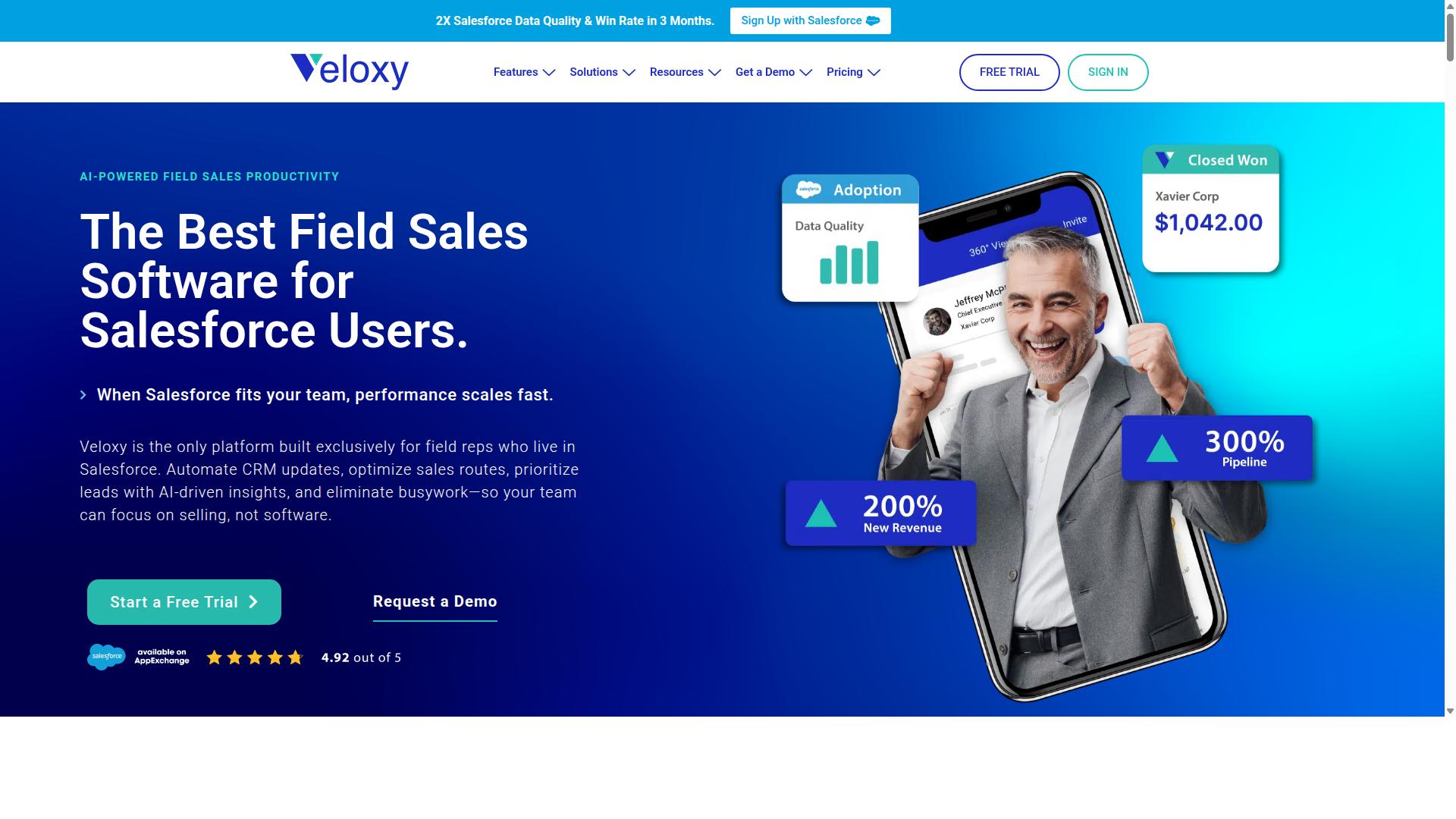
Veloxy stands out as the best overall portatour alternative because it combines AI-powered sales enablement with deep Salesforce integration, making it a top choice for field sales teams. Unlike generic route planning tools, Veloxy was built exclusively for field reps who live in Salesforce. This focus means every feature supports the way outside sales professionals actually work.
For managers, Veloxy delivers visibility into daily visit planning, territory management, and sales rep tracking without forcing teams to juggle multiple apps. The platform is recognized as the #1 Field Sales Software for reps and managers using Salesforce. It also holds strong ratings on G2, with Enterprise Reviews at 4.86, Mid-Market Reviews at 4.71, and Small Biz Reviews at 4.76.
What really separates Veloxy from portatour is the measurable impact. After 3 months, Veloxy customers double their sales productivity, double pipeline and revenue, and effectively pay for their annual Salesforce cost. Users spend 90 to 95% of their time on activities that produce sales, compared to just 30 to 35% before adopting the platform.
AI-Powered Field Sales for Salesforce Users
Veloxy's AI Sales Assistant automates lead qualification, pipeline management, and guided selling, saving reps over 60 minutes daily, as reported by Comcast's Sonny Hawkins. This time savings comes from reducing manual data entry and administrative busywork. Instead, reps focus on customer visit scheduling, client meetings, and closing deals.
The AI capabilities go beyond basic automation. Veloxy provides buying signals, lead scoring, and predictive forecasting directly within the Salesforce environment. This helps field teams prioritize which accounts deserve a visit and which opportunities need immediate attention. The result is smarter sales visit planning backed by real data.
Comcast experienced a 10X increase in sales engagement using Veloxy. Sonny Hawkins noted that the platform improves Salesforce adoption and overall sales engagement across the team. When reps spend less time on data entry, they spend more time in front of customers, which directly impacts revenue.
For field sales teams, the combination of route optimization software and AI guidance creates a powerful workflow. Reps get a daily visit planner that accounts for geolocation and territory mapping. Managers get sales analytics and performance tracking through a clean sales dashboard. Veloxy also offers 200+ reviews on Salesforce AppExchange and 190+ reviews on Capterra, reinforcing its reputation.
Vast Networks grew sales by 400% in two months, and Wex saw a 10X improvement in sales enablement. Jose Rivera from Wex highlighted the one screen, one click approach that saves thousands of dollars annually in selling time. These examples show that Veloxy is not just a route planning tool, it is a complete field sales operating system.
With 500+ testimonials available on trusted review sites, Veloxy has proven itself across industries. The platform is recognized by G2 for Best Relationship and is recommended by top software review sites. For teams already using Salesforce, Veloxy delivers the deepest integration and the strongest ROI of any portatour alternative.
2. SPOTIO
SPOTIO is a dedicated field sales app known for its route planning and territory management features, but it lacks the deep AI integration found in Veloxy. It is designed for door-to-door and outside B2B reps who spend their days moving between customer locations.
The platform emphasizes territory and pin mapping, which lets teams visualize where their prospects and customers are located on an interactive map. This makes it a practical sales territory mapping tool for managers who need to assign regions and keep reps focused on high-density areas.
Its route optimization software helps sales reps sequence their daily visits more efficiently. Instead of guessing which stop comes next, the app suggests a logical order that reduces drive time and keeps the sales force in the field longer.
SPOTIO also supports visit logging and client visit logs, allowing reps to record what happened at each stop. This field sales software captures notes, outcomes, and next steps, which feeds into basic visit reporting for managers who want visibility into daily activity.
The mobile-first design is one of its strongest attributes. Since reps are rarely at a desk, the app is built for quick check-ins, easy navigation, and on-the-go data entry. Many users find it intuitive and simple to adopt across a team.
However, there are limitations worth noting. SPOTIO offers fewer sophisticated AI technology compared to more modern platforms. It focuses on the core mechanics of field work rather than predictive analytics or automated sales visit planning suggestions.
Its customer relationship management integration depth is also more limited. While it connects to common CRM systems, it may not offer the same level of two-way sync or data enrichment that teams with complex sales pipelines require.
For teams that need a straightforward sales route planner with strong geolocation and territory management, SPOTIO is a solid choice. Starting at $39 per user per month, it is positioned as an accessible option for route-heavy teams that prioritize simplicity over deep automation.
3. SalesRabbit
SalesRabbit focuses on lead management and territory mapping, making it a solid choice for teams that prioritize simple, visual territory management over advanced AI. It is a field sales app built around canvassing, lead generation, and the day-to-day logistics of knocking on doors or visiting prospects. For organizations that run appointment-based sales or door-to-door campaigns, the platform provides a clear view of where reps have been and where they should go next.
The core workflow centers on lead distribution and visit tracking. Managers can assign leads to specific reps, set up territories on a map, and monitor activity in real time. This makes it easier to spot coverage gaps and ensure that no high-value address gets missed. The interface is designed to be straightforward, so field teams can log visits quickly without spending too much time on data entry between stops.
SalesRabbit also integrates with common CRM systems, which helps sales data flow back into a central customer relationship management record. This reduces the need for manual updates after a day of knocking. However, analytics capabilities are somewhat limited compared to more advanced field sales software. Teams that need deep reporting on sales rep tracking, conversion trends, or detailed sales performance tracking may find the built-in dashboards less flexible than they would like.
Another consideration is offline functionality. While the platform works well in connected areas, offline sales app capabilities can be inconsistent depending on the plan and device. Reps working in rural regions or buildings with poor connectivity may need to plan accordingly. Pricing is available on a per-user basis, with team plans starting at $59 USD per user per month, and a Pro tier at $75 USD per user per month when billed monthly. For smaller teams focused on territory management and lead routing, SalesRabbit offers a practical, no-frills option that gets the job done.
4. SimplyDepo
SimplyDepo offers a user-friendly interface for visit planning and route optimization, but may not offer the same level of AI-driven insights as more advanced tools. It is built as an all-in-one mobile platform for CPG brands, distributors, and merchandisers to simplify B2B field sales, retail execution, and route planning.
The platform focuses on practical, day-to-day field operations rather than complex enterprise analytics. Teams can handle mobile order entry with real-time product and pricing access, which keeps the sales process moving even when reps are far from the office.
Key features that stand out for field teams include:
- Route planning with integrated maps for efficient travel between stops
- Shelf data capture, photos, and store audit notes for retail execution
- CRM-style customer tracking to maintain account history and context
- Offline support so reps can keep working without a stable connection
- Real-time dashboards for managers monitoring daily activity
The platform suits CPG brands, distributors, and merchandisers that need a straightforward way to manage field activity. It also offers integrations with QuickBooks, Zapier, and an open API, which helps connect the tool to existing business systems without heavy customization.
Pricing is not stated publicly, so interested teams would need to contact the vendor directly. This can make budgeting less transparent compared to tools with published plans.
For smaller operations, SimplyDepo's simplicity is a real advantage. Teams can get up and running quickly without extensive training. However, the platform may feel limited for larger organizations that need advanced sales analytics, territory management, or deep sales force automation capabilities.
If your priority is a clean, affordable route optimization software with solid customer management, SimplyDepo is worth evaluating. Just consider whether your future growth will demand more sophisticated sales visit planning and reporting than the platform currently offers.
5. Skynamo
Skynamo is a field sales management platform that excels in visit reporting and team collaboration, but it may require more configuration to match the AI capabilities of some alternatives. The software is tailored for wholesale and distribution businesses, making it a practical choice for brands, distributors, and merchandisers who rely on consistent field activity.
One of Skynamo's strongest areas is visit reporting and order taking. Sales reps can log client visits quickly, capture orders on the spot, and share updates with the wider team without juggling multiple tools. This keeps the sales pipeline moving and reduces the back-and-forth that often slows down field operations.
Team communication is another clear strength. Managers can see what reps are doing in real time, which supports better field team management and sales performance tracking. The platform also integrates with ERP and Salesforce systems, so businesses can connect their field data with accounting and customer relationship management workflows already in place.
That said, Skynamo may come with a learning curve. Because it is built for a specific type of sales operation, teams with more complex territory management or sales route optimization needs might have to invest time in customization. It is not always the most flexible option for companies that want a ready-made, AI-driven route planning tool out of the box.
For organizations that prioritize clean visit logs, order accuracy, and clear communication between reps and managers, Skynamo is a credible option. However, buyers should weigh the setup effort against their need for advanced automation and sales visit planning features. It is a solid field sales app, but not necessarily the lightest to configure for every team.
6. Map My Customers
Map My Customers provides robust territory mapping and route planning, making it a practical choice for sales teams that need to optimize daily travel. This field sales software focuses on helping outside sales representatives see their accounts visually, organize their day, and reduce time spent behind the wheel.
The platform is known for its visual appeal and ease of use. Sales reps can quickly view customer locations on a map, group stops by region, and build efficient daily visit plans. For teams that rely heavily on sales territory mapping, the interface simplifies what can otherwise become a complex scheduling puzzle.
Map My Customers offers native two-way CRM sync with popular systems like Salesforce, HubSpot, Zoho, and Dynamics. This integration helps keep customer relationship management data current without manual entry, which is a major time-saver for field teams. The mobile experience is designed for on-the-go use, allowing reps to update records and capture leads directly from their devices.
The platform also includes several AI-driven features, such as Smart Planner and AI Field Agent, which assist with sales visit planning and daily route suggestions. These tools aim to improve sales productivity by reducing the guesswork involved in scheduling appointments and managing territories.
However, Map My Customers may not offer the same depth of predictive analytics found in some broader sales force automation tools. While it excels at route optimization software and territory management, teams looking for advanced forecasting or complex pipeline insights might find its reporting capabilities more limited. It is best suited for B2B field sales teams that prioritize geolocation accuracy and straightforward visit reporting over extensive back-office analytics.
For organizations that need a dependable sales route planner with strong visual tools and solid CRM connectivity, Map My Customers is a credible option. It handles the core logistics of customer visit scheduling well, though buyers should evaluate whether its feature set aligns with their long-term needs for sales analytics and sales performance tracking.
7. Mapsly
Mapsly integrates with major CRMs to provide territory mapping and route optimization, but it may not offer the same level of sales-specific AI features. This platform focuses on the geolocation side of field operations, making it a practical choice for teams that heavily rely on spatial data.
For organizations using platforms like Salesforce or HubSpot, Mapsly's real-time sync keeps CRM records aligned with field activity. The system supports 15 or more CRM integrations, which means your existing customer relationship management data can feed directly into your mapping views without duplicate data entry.
The mapping capabilities are the standout feature here. Teams can draw or import territories worldwide, then visualize their entire sales territory mapping in one dashboard. This makes it easier to spot coverage gaps, balance workloads across reps, and understand where your daily visit planner needs adjustment.
Mapsly also handles complex routing scenarios. It optimizes routes for entire teams in a single run, supporting multi-rep, multi-day scheduling with thousands of stops. Offline maps are available on both iOS and Android, which is essential for field sales teams working in areas with spotty connectivity.
Key features that stand out for field teams include:
- Customizable maps with real-time data sync
- Offline access to CRM data and route planning tools
- Territory drawing, importing, and worldwide coverage
- Analytics with more than 40 chart types and SQL query options
- Mobile app for route planning, check-ins, and data collection
That said, Mapsly is not primarily a sales force automation tool. Sales workflow automation is more limited compared to dedicated field sales software. If your team needs advanced lead management, automated follow-up sequences, or AI-driven visit recommendations, you may find Mapsly lacking in those areas.
Pricing is published on their website with no seat minimum, and a free trial of the full platform is available. This makes it easy to evaluate whether the mapping depth justifies the trade-off in sales-specific features.
For teams that are outgrowing basic route planning tools and need serious geolocation capabilities, Mapsly is worth considering. However, if your priority is a complete field sales platform with stronger automation and sales analytics, you may need to pair Mapsly with additional software to cover those gaps.
How to Choose the Right Option
Choosing the right portatour alternative depends on your team's size, your CRM, and whether you prioritize AI-driven insights or simple route planning. A field sales app that works for a five-person team may not scale smoothly to fifty reps, so start by mapping your current workflow before comparing features.
Begin with a short checklist of non-negotiables. Do your reps need a sales route planner that works offline? Does your manager rely on visit reporting and sales rep tracking for weekly reviews? Write down the three or four tasks your team performs daily, then match each tool against that list.
Next, consider your existing tech stack. If your organization runs on Salesforce, a mobile CRM that integrates directly will save hours of duplicate data entry. Teams using other CRMs should confirm that any route optimization software offers native sync or a reliable API bridge.
Finally, think about adoption. A powerful tool that feels complicated will frustrate field teams. Look for a sales visit planning interface that matches your reps' skill level, and check whether the vendor offers a free trial so your team can test real workflows before committing.
Comparing Pricing, AI Capabilities, and CRM Integration
When comparing options, note that Veloxy offers transparent pricing at $65 per user per month with a free trial, while others may have tiered plans or hidden costs. Veloxy also provides a 14-day free trial, and annual subscriptions save 25 percent. A three-year commitment brings a 50 percent savings, bringing the cost to about $2 per day for a full-featured field sales app.
For larger teams, Veloxy offers company plans at $899 per month for 25 members, with annual plans saving 45 percent. The brand also backs its value with a simple guarantee: if you don't get ROI in 3 months, you get 3 months free. Other tools in this space typically use per-user pricing or custom enterprise quotes, so request a detailed breakdown before signing.
AI capabilities vary widely across route planning tools. Some focus purely on GPS tracking for sales and daily visit planner functions, while others add sales analytics and lead management. Veloxy is designed for field sales teams using Salesforce, making AI-powered insights a natural fit for reps who already live inside that CRM.
CRM integration matters for data accuracy. When your sales route optimization tool syncs with your customer relationship management system, visit notes, client visit logs, and appointment scheduling stay consistent. A sales force automation tool that requires manual exports defeats the purpose of automation, so verify integration depth during any trial period.
Consider these factors when evaluating your shortlist:
- Pricing model: Per-user, per-team, or annual flat rate
- AI features: Predictive routing, smart scheduling, or basic mapping
- CRM sync: Native integration, API, or manual export
- Offline access: Critical for rural or low-connectivity territories
- Scalability: Can the tool grow from 5 to 500 reps
Sales territory mapping and geolocation features should also factor into your decision. A route planning tool that handles territory management well reduces drive time and keeps reps focused on high-value accounts. Weigh these capabilities against your budget and the learning curve your team can absorb.
Final Verdict
After evaluating all options, Veloxy emerges as the best all-around portatour alternative for Salesforce-centric field sales teams, thanks to its AI-powered features and proven results. The other tools on this list handle specific needs well, from basic route optimization software to general mobile CRM platforms. But none of them combine deep Salesforce integration with a focus on the daily realities of field reps.
Consider what each alternative offers. Some excel at sales route planning and GPS tracking for sales, making them solid choices for teams that need basic territory management. Others provide strong customer visit scheduling or visit reporting features. However, most require your team to switch between multiple apps to manage their day, which costs time and hurts sales productivity.
Veloxy solves that problem by being the only platform built exclusively for field reps who live in Salesforce. Your team never leaves their familiar environment. They get everything they need, from a daily visit planner to sales analytics, without juggling separate tools. The result is a workflow that feels natural and keeps the sales pipeline moving.
The results speak to the platform's design. After 3 months, Veloxy customers double their sales productivity, pay for their annual Salesforce, and double pipeline and revenue. These are not incremental gains. They represent a fundamental shift in how field teams operate. Veloxy users spend 90 to 95% of their time on activities that produce sales, compared to just 30 to 35% before adopting the platform.
Industry recognition reinforces this performance. Veloxy holds a G2 recognition as Highest Performer, with enterprise reviews at 4.86, mid-market reviews at 4.71, and small business reviews at 4.76. The platform also carries 190+ reviews on Capterra and 200+ reviews on Salesforce AppExchange. Top software review sites recommend Veloxy as a leading field sales app.
For teams weighing their options, the choice depends on your priorities. If you need a simple sales route planner and do not use Salesforce, a standalone route planning tool might suffice. If your organization relies on Salesforce for customer relationship management and lead management, Veloxy is the clear winner. It is the #1 field sales software for reps and managers using Salesforce, and it guarantees that no other field sales app offers as many critical features at this price.
We recommend Veloxy for field teams that want to maximize time on selling activities, improve sales performance tracking, and simplify their tech stack. It addresses the core challenges of field team management in one place. The platform is recognized by G2 for Best Relationship and is led by Sales AI Pioneers, so you are adopting technology from a team that understands the space deeply.
To see if Veloxy fits your workflow, take advantage of the 14-day free trial. This gives your team a real chance to test the daily visit planner, sales dashboard, and geolocation features with your own data. You can evaluate how it improves your sales visit planning before making a long-term commitment.
For any questions or to get started, contact the Veloxy team directly through the website. They also offer a free resource, Samir's Big Blue Book of Field Sales, to help you refine your field sales strategy. Choosing the right field sales software is a big decision. With Veloxy, you get a proven path to higher sales productivity and better results for your Salesforce-based team.
LINKBLOCK:START LINKBLOCK:END